April Fools Day 2D Illustrations & Graphics
As a handmade business owner who’s shipped over 3,000 custom mugs, planner sticker sets, and seasonal gift bundles since 2018—and who’s also run two successful Etsy shops—I opened April Fools Day 2D Illustration with one question: “Can I turn this into real products customers will love *and* actually sell?” The answer? A confident yes—but only if you know how to use it right.
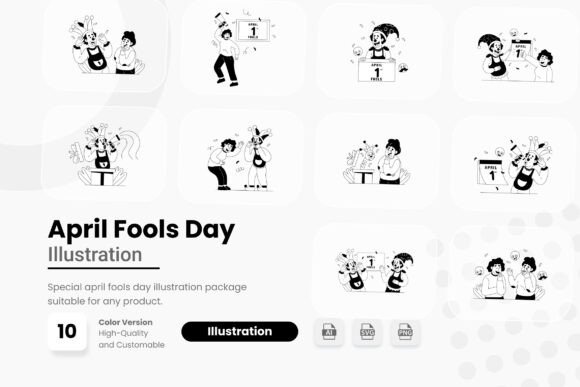
My first impression was immediate: this is playful, unapologetically cheerful, and full of comic-style charm. Think exaggerated winks, cartoonish pranks (a banana peel mid-slip, a fake “out of order” sign), confetti bursts, and speech bubbles with cheeky phrases like “Gotcha!” or “April Fool!” It leans bold and festive—not elegant or minimalist—so it naturally attracts buyers who love lighthearted humor, nostalgic party energy, and whimsical handmade goods. If your ideal customer shops at craft fairs for fun tote bags, buys printable birthday planners on Etsy, or orders custom stickers for their small business team, this asset fits like a glove.
Where April Fools Day 2D Illustration Shines in Real Crafting
This isn’t just clipart—it’s a versatile graphic design asset built for action. I tested it across six real production workflows:
- Cricut & Silhouette projects: The SVG files imported cleanly into Design Space and Silhouette Studio. All outlines were smooth, no stray nodes or overlapping paths—critical when cutting vinyl for mugs, tumblers, or wall decals. I used the “prank mirror” illustration as a tumbler wrap and resized it to 3.5" tall without jagged edges.
- Sticker design: The PNGs have crisp transparency and hold up beautifully at 2"–4" sizes. I printed them on matte vinyl and die-cut them for planner sticker sheets—no bleed or halo around the edges.
- Mug & t-shirt design: Paired with a bold sans serif font (“Bebas Neue”) and a simple border, the illustrations scaled well for sublimation mugs and DTG-printed tees. The vibrant palette pops on white and light heather gray.
- Printable design: I dropped the “confetti burst” element into a 5x7” party invitation layout and a set of gift tags. At 300 DPI, it printed sharp and color-accurate on both matte cardstock and kraft paper.
- Handmade packaging: Used the “fake diploma” illustration (with editable text layer) on thank-you cards tucked into Etsy orders—customers loved the inside joke.
- Small business branding: Added the “wink-and-nod” icon to my shop banner and Instagram story highlights. It subtly reinforced our brand voice: friendly, clever, and authentically handmade.
Best Uses for Your Handmade Business
April Fools Day 2D Illustration works hardest in these high-value contexts:
- Seasonal craft bundles (e.g., “Prank Pack” with matching stickers, gift tags, and printable party games)
- Etsy digital product listings—especially printable planner pages, party kits, and social media templates
- Product mockups that convert: use it on realistic tumbler, mug, and tote bag mockups to show scale and vibe
- Print-on-demand integrations (like Printful or Gelato) where clean vector lines and RGB-ready colors matter
- Local market displays—printed large on banners or mini posters to draw smiles and spark conversations
Where to Use It Carefully
Not every illustration translates perfectly across all mediums. Here’s what I flagged during testing:
- Very small cutting details: The “tiny prank whistle” element has fine interior lines—too delicate for cuts under 0.75". Skip it for tiny iron-on transfers or micro-stickers.
- Thin-line elements: One speech bubble uses a 1-pt stroke—barely visible when reduced for 1" stickers. I thickened it manually in Illustrator before exporting.
- Crowded compositions: The “prank collage” layout is fun but too dense for heat-transfer vinyl on dark shirts. I isolated individual icons instead.
- Low-contrast pairings: Yellow-on-light-yellow confetti didn’t print clearly on kraft paper. Always test color combos on your actual substrate.
- Layered vinyl projects: Some illustrations include overlapping shadow layers—great for depth, but tricky for multi-layer weeding. Simplify by flattening unless you’re experienced.
Practical Crafter Notes You’ll Actually Use
Before adding April Fools Day 2D Illustration to your next batch of handmade products, do these five things:
- Test the SVG design in your cutting software—zoom in at 400% to check for hidden anchor points or compound paths that might cause cut errors.
- Preview the PNG design with transparency turned on in Photoshop or Canva—some apps default to white background and hide clipping issues.
- Confirm resolution for sublimation design: Open the highest-res PNG and verify it’s ≥300 DPI at your intended print size.
- Test colors on both white and dark products—I printed the same “joke book” icon on white ceramic mugs and black tumblers; adjusted saturation slightly for the latter.
- Always place it on a real product mockup—not just a blank canvas. Seeing it on a curved tumbler or stitched tote bag reveals scaling and balance issues no thumbnail preview shows.
Font pairing matters too. This illustration style sings with bold sans serifs (for t-shirts), rounded handwritten fonts (for planner stickers), or playful display fonts (for party invitations). Avoid thin serifs—they get visually lost against the bold, comic-style graphics.
And don’t skip the license check. I confirmed this is a commercial license—meaning you can use it in customer orders, Etsy products, craft fair sales, and even print-on-demand services. But always re-read the terms: some creators limit resale of unaltered digital files, so if you’re selling SVGs directly, double-check.
In my shop, April Fools Day 2D Illustration became the backbone of a limited-run “Prank Season” collection—12 mugs, 3 sticker sheets, 5 printable party games, and 200+ social media posts. It didn’t just look fun. It sold. Because it’s not just decoration—it’s a ready-made piece of creative strategy for handmade businesses who value authenticity, efficiency, and joyful design.