Whimsical Fairy Tale Clipart
A Designer’s First Glance: Charm Without Clutter
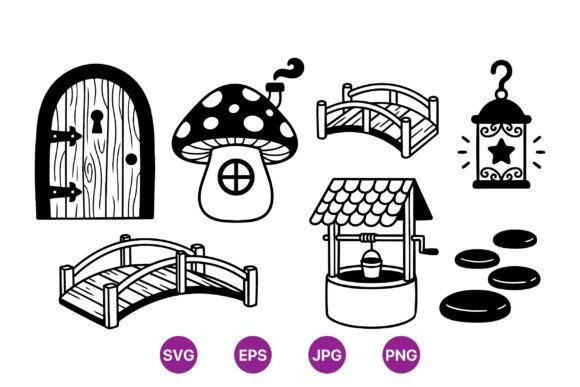
Opening Whimsical Fairy Tale Clipart feels like flipping open a storybook sketch—soft, intentional, and quietly confident. It’s a hand-drawn vector set centered on a fantasy mushroom house with chimney, wooden door (complete with keyhole), decorative lantern, stone path, and two gently curved garden bridges. Rendered in clean black-and-white line art, it doesn’t shout—it invites. As an embroidery designer who’s stitched everything from nursery onesies to boutique aprons, I immediately sensed its quiet versatility: this isn’t just clipart; it’s a ready-made narrative thread for handmade products that need warmth, wonder, and wearability.
Real-World Test: Stitching It onto a Linen Tote Bag
Last week, I prepped a custom order—a linen tote bag for a local children’s bookstore owner, meant to hold storytime supplies and double as a gift. I chose Whimsical Fairy Tale Clipart as the centerpiece because its organic lines and balanced negative space translate beautifully into stitch. No frantic reworking was needed: the mushroom cap’s gentle curve reads clearly in satin stitch, the stone path holds up well as a running-stitch border, and the lantern’s delicate loop stays legible even at 3.5" wide. Customers notice details like that—the kind that make a handmade product feel *considered*, not just decorated.
Where It Shines (and Why)
- Personalized gifts: Baby onesies, pillow covers, and tea towels gain instant storybook charm—ideal for nurseries, birthdays, or holiday keepsakes.
- Small business merchandise: Works seamlessly on aprons, sweatshirt pockets, or embroidered patches for craft fairs or Etsy listings.
- Digital product previews: Its clean line art style renders crisply in printable mockups—no pixelation, no guesswork when showing clients or shoppers what the finished product will look like.
- Commercial embroidery: The consistent stroke weight and uncluttered layout reduce digitizing time and minimize stitch density surprises—especially helpful if you’re outsourcing digitizing or building your own embroidery file library.
Stitching Smart: Where Caution Meets Creativity
Not every surface welcomes whimsy equally—and Whimsical Fairy Tale Clipart is no exception. On thin cotton tees? Yes—but use lightweight cutaway stabilizer to prevent puckering around the lantern’s fine loop. On stretchy fabric like jersey? Scale down slightly and avoid placing near seams or curved areas like cap crowns unless you’ve tested hoop tension and fabric recovery first. Dark fabrics demand thoughtful thread color choices: a soft ecru or oatmeal satin stitch on charcoal linen reads more elegantly than stark white, preserving the design’s gentle mood.
Its black-and-white line art nature means it adapts beautifully to monochrome embroidery—perfect for minimalist branding or vintage-inspired shop goods—but resist overloading it with dense fill stitches. This isn’t a design built for heavy texture; it thrives in clarity. If you’re planning an applique design, treat the mushroom house as a focal shape and keep background elements light—maybe a single running-stitch stone path beneath, nothing more.
What It Adds to Your Craft Business—Beyond Aesthetics
For Etsy sellers and small shop owners, Whimsical Fairy Tale Clipart quietly elevates perceived value. It signals attention to detail—not just “cute,” but *cohesive*. When customers see that lantern’s subtle curve echoed in your shop banner or packaging stamp, brand consistency deepens without extra effort. It also boosts buyer engagement: parents scrolling for baby embroidery pause longer on items that tell a visual story, and gift buyers trust pieces that feel intentionally designed—not algorithmically assembled.
As a reviewer who’s seen hundreds of digital embroidery files, I’ll say this plainly: many fairy-themed graphics drown in ornamentation. Whimsical Fairy Tale Clipart avoids that trap. Its restraint makes it more usable—not less. You can scale it from 2" on a child’s cap to 6" on a kitchen towel without losing legibility or balance. That flexibility saves time across projects, whether you’re prepping for a holiday embroidery rush or building evergreen design assets for your craft business.
Practical Notes Every Embroidery Designer Should Check
- Test on scrap fabric first—especially if using textured linen or terry cloth, where fine lines may blur.
- Review stitch density before finalizing any machine embroidery design—this set leans light, but confirm fill areas (like the mushroom cap base) won’t shift on delicate fabrics.
- Confirm hoop size compatibility: its horizontal span suits standard 4x4 hoops, but the full scene (mushroom + bridges + path) may require 5x7 or larger for optimal spacing.
- Inspect small details in your embroidery software—keyholes, lantern loops, and bridge curves should remain open and distinct after digitizing.
- Try black-and-white mockups to gauge contrast on both light and dark backgrounds—this helps choose thread colors that honor the original line art’s intent.
- Verify licensing before selling finished products or bundling it into digital embroidery files—since it’s categorized as Illustrations and Graphics, commercial use terms may vary by seller.
The Bottom Line for Makers Who Value Real Results
Whimsical Fairy Tale Clipart isn’t magic—it’s thoughtful design made practical. It won’t solve every embroidery challenge, but it meets real needs: clarity on varied fabrics, adaptability across product types, and emotional resonance that sells itself. Whether you’re stitching a personalized gift for a friend or scaling production for your craft business, this set earns its place in your design assets—not because it’s trendy, but because it works. Quietly. Reliably. With just enough magic to remind people why they love handmade.